Recently, I made many friends from different races in KMS. Knowing them made me eager to know more about the system of naming of these different races. Personal names in Malaysia strictly define a person's cultural background as Malaysia comprises many cultures and races, and each has a distinctive system of naming. Personal names are somewhat restricted by government administration, especially since the introduction of the MyKad identity card. Malaysian Chinese are the only major ethnic group in Malaysia to use family names. Most other groups, including the dominant Malays, use a personal name followed by a patronym.
Let's begin with Malay names,
Malay names are often drawn from Arabic and follow some Arabic naming customs. Although some names have Malay, Javanese or Sanskrit origin, as Muslims, Malays have long favoured Arabic names as marks of their religion.
A Malay's name consists of a personal name, which is used to address him or her in all circumstances, followed by a patronym. Most Malays do not use family names. In this respect, Malay names are similar toIcelandic naming conventions. For men, the patronym consists of the word bin (from Arabic بن, meaning 'son of') followed by his father's personal name. For women, the patronym consists of the word binti (from Arabic بنت, meaning 'daughter of') followed by her father's name. Upon marriage, a woman does not change her name, as is done in some cultures.
Sometimes the first part of the patronym, bin or binti, is reduced to B. for men, or to Bt., Bte. or Bint. for women. This sometimes leads to it being taken as a middle initial in Western cultures. In general practice, however, most Malays omit the word bin or bint from their names. Thus, the two examples from the paragraph above would be known as Musa Osman and Aisyah Musa. When presented in this way, the second part of the name is often mistaken for a family name. However, when someone is referred to using only one name, the first name is always used, never the second (because you would be calling someone by his or her father's name).
Secondly, let's talk about Chinese names,
Traditional Chinese names are used among Malaysian Chinese. These names are usually represented as three words, for example Foo Li Leen or Tan Ai Lin. The first name is the Chinese family name, which is passed down from a father to all his children. The two other parts of the name form an indivisible Chinese given name, which may contain a generation name. In Western settings, the family name is sometimes shifted to the end of the name (for example, Li Leen Foo).
Last but not least, Indian names,
Officially, Malaysian Indians use a patronymic naming system combining their traditional Indian names with some Malay words, while others use Sanskrit names. A man's name would consist of his personal name followed by the Malay phrase anak lelaki, meaning 'son of', and then his father's name. A woman's name would consist of her personal name followed by the Malay phrase anak perempuan, meaning 'daughter of', and then her father's name. The Malay patronymic phrase is often abbreviated to a/l ('son of') or a/p ('daughter of') and then their father's name. In many circumstances, the intervening Malay is omitted, and the father's name follows immediately after a person's given name. Following traditional practice from South India, the father's name is sometimes abbreviated to an initial and placed before the personal name. Thus, a man called Anbuselvan whose father is called Ramanan may be called Anbuselvan anak lelaki Ramanan (formal), Anbuselvan a/l Ramanan (as on his government identification card), Anbuselvan Ramanan or R. Anbuselvan. Whereas, his daughter Mathuram would be called Mathuram anak perempuan Anbuselvan (formal), Mathuram a/p Anbuselvan (as on her government identification card), Mathuram Anbuselvan or A. Mathuram. Although not recorded officially, an Indian woman may use her husband's personal name instead of her father's name after marriage.
As you all see, Malaysian names are unique and interesting for each races. Hope this information would help you all understand Malaysian more. Thanks for reading and have a nice day. =)


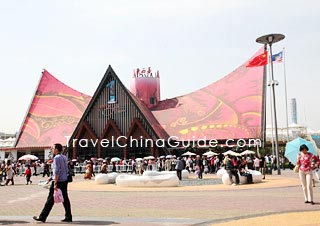
 Malaysia Pavilion's theme is heme: "One Malaysia, City Harmonious Living". The inspiration of the pavilion design comes from the traditional Malaysian hut in the expression of a unique style and national spirit of union. The building will comprise two streamlined high slopes with a cross on top, the symbol of Malaysian architecture. The facade of the pavilion will be made from a combination of recyclable materials of palm oil and plastic. It showcases rural building with Minangkabau's "Rumah Gadang" architecture. After the Expo, the pavilion is to be donated to the county of Wuxi in the People's Republic of China. It's designed due to Malaysia's uniquity of being multi-racial and multi-cultural.Visitors will encounter world heritages of Penang and Malacca and get access to characteristic Malaysian artworks and their production process. Electronics, rubber and timber products will also be exhibited in the pavilion.